
Cambridge Water has announced a hose pipe ban, starting at 1am from Friday 17 July. As someone who earns her living gardening, it’s not something that is going to make my working life easier, but on the other hand I have been expecting it.
Water is a precious resource and is only going to be more so. Due to climate change, a growing population and the appalling mismanagement of and by our water companies, my aim has been for some time now to reduce our water use at home and not to use any mains water in the garden. With success. In 2026 I haven’t used any mains water for plants in the garden yet and even in this third heatwave there’s still about 2500 litres in the water butts.
Below I will set out some easy steps that you can take now so your garden survives the heatwave and ones that you can take to make your garden more drought resistant in the future.
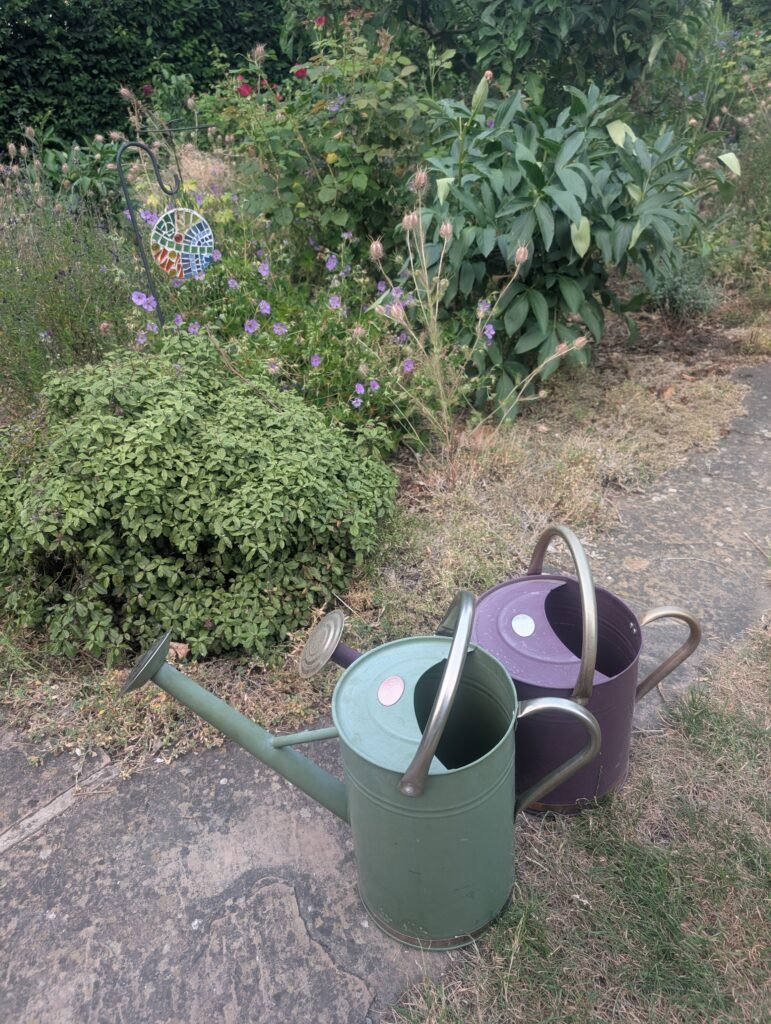
look awful in Summer, but then
jump back into life when it gets cooler. It's amazing in Spring so hence I tolerate its bad behaviour now.
1. Start using (more) grey water
We have a washing up bowl in the sink and every bit of water goes in there and then in the garden: dishwasher water, pasta cooking water, handwashing, rinsing milk bottles, washing fruit and veg, etc. The only time it's not going in the garden is when there’s a lot of salt in it (ie soy sauce) or anything else that is not good like sodium bicarbonate. Do research if your washing up liquid and handsoap are ok for grey water use and otherwise switch to one that is fine. The grey water will look pretty gross at times, but the soil microbes will love it all. We have a tub trug near the back door in case the water needs to cool down or if a family member doesn’t know which plant needs it.
Also think about the other uses of water in your house. I met someone who syphoned her bathwater with a hose from the tub, through the window, down into the garden. We put a bucket in the shower to catch the first cold water and I have made a contraption for the rinse water from the washing machine. This needs careful timing, so it’s not something we manage often.
2. Mulch, mulch, mulch
Mulches protect your soil from the heat, prevent (some) weeds and reduce evaporation. Meadowmania recently did some temperature measurements (link). When the ambient temperature was 26C, bare soil was 33C. Better of course would be to have ground cover plants which will lower the temperature at least by 5C or more, depending on the canopy and height of your plants, but if there are no plants now, mulch your soil. Compost, bark or even grass clippings are all good.
Best practice is to mulch your soil every year. Not only will you feed the soil microbes and thus your plants, but you are also adding organic matter which will help with future water retention. The organic matter works as a sponge, so once worms have pulled it down, it helps plants by behaving like a sponge in the rhizosphere.
At home we have several large compost bins and the compost is used for mulching. We also shred hedge clippings etc, which are often used straight next to plants, as are the grass clippings, which usually go into the veg garden (but not on the carrots who don’t like the nitrogen).
3. Install water butts
The best place for a water butt is onto a downpipe from a large roof. 1 cm of rain falling on 1 m² of roof equals exactly 10 litres of water. So your 6x8ft shed will get you 45 litres of water. If your house has a foot print of 40 m² (it'll probably have more) you'll collect 400 litres.
A properly installed water butt will not give you any problems with regards to your house. As with the guttering, you’ll need to make sure that the water goes where it needs to. When installing, do be mindful though that the guttering/downpipe connection may need adjusting, so you need to be able to reach the roof. If your roof is very high and you won't be able to reach it, installing a water butt is best done when you already have scaffolding or planned roof works.
Over the years we have heavily invested in water butts. We have two 1000 litre tanks and another 16 water butts on every downpipe and outbuilding with just two exceptions for aesthetic reasons. The total capacity is just over 5000 litres. All were as good as empty at the beginning of June when luckily, we got some nice rain. By carefully syphoning full ones which take water from the house into empty ones (ie those connected to a small outbuilding), just before rainfall or even during a downpour, meant that most of the rain was collected. Thus, at the time of writing on 9th July, there still is about 2500 litre spread over a large number of water butts. I have two ponds and a small water feature which need rainwater, so a large part of that is reserved for the aquatic life.
4. Plant for drought
For the long-term drought tolerant plants are the solution. After every drought I decide to dig out another hydrangea as they are too much work in Cambridge with our worsening semi-arid climate. Make a note of which plants are doing well in this weather and which plants are not coping, both in your own garden and in other gardens. It may not be the ones that the garden catalogues tell you. This year the Japanese anemones have really struggled in places whereas Penstemon 'Sour Grapes' and Saponaria ocymoides (Rock Soapwort) have needed no watering at all. Also the obvious Mediterranean choices like salvias, lavenders and rosemary don’t like to sit in boggy ground in the Winter, so you may need to carefully think about where to plant those and possibly make adjustments to the garden by adding loads of organic matter and grit.
Also make a note of where you lack ground cover and make a plan to have no bare soil next year.
The best time for planting is the Autumn, then Winter (although don’t do that for plants who hate the wet) and then Spring . The aim is to have plants established with a nice bit of mulch around them before the first drought.
So the work to change the planting starts now, not next May when the soil is dried up again.
5. Rationalise your pots
Pots are lovely, but also thirsty and thus a lot of work. When drought is the main problem, buy large pots, at least 10 litres, preferably more. Adding crocks to a pot for drainage and Styrofoam as a cheap filler (!!! Please don’t, it’s full of toxins and turns into microplastics) will increase the need for watering. First of all you want soil and compost in your pots as it holds water and then either a large saucer under it, or turn it into a self-watering pot. You also really don’t want small pots as they expose a much higher proportion of their soil and roots to the outside, allowing the wind and sun to dry them out.
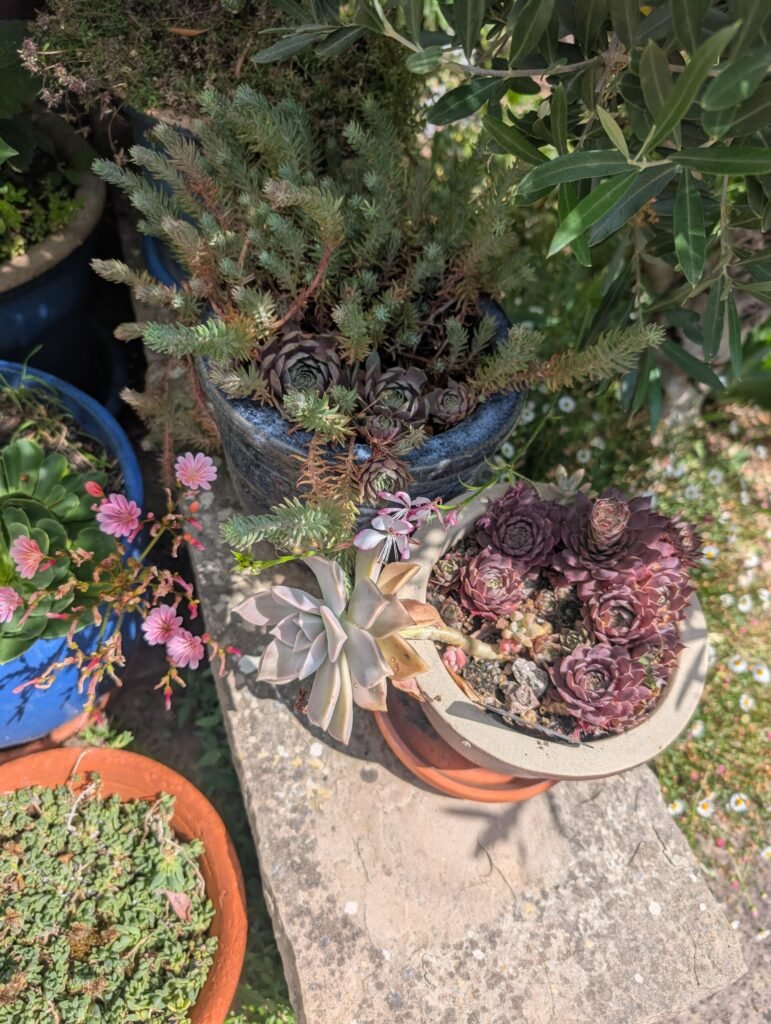
We have bought some self-watering pots, which work well, but they still need water every day in hot weather. The mint collection and quite a few other pots have a (take away/butter/mushroom) container at the bottom over the hole as they don’t mind having some of their roots in wet soil. Excess water will still find its way out of the pot. Some pots further away from the house have succulents in them which are beautiful and require hardly any watering.
6. Use some gadgets, but don’t waste your money
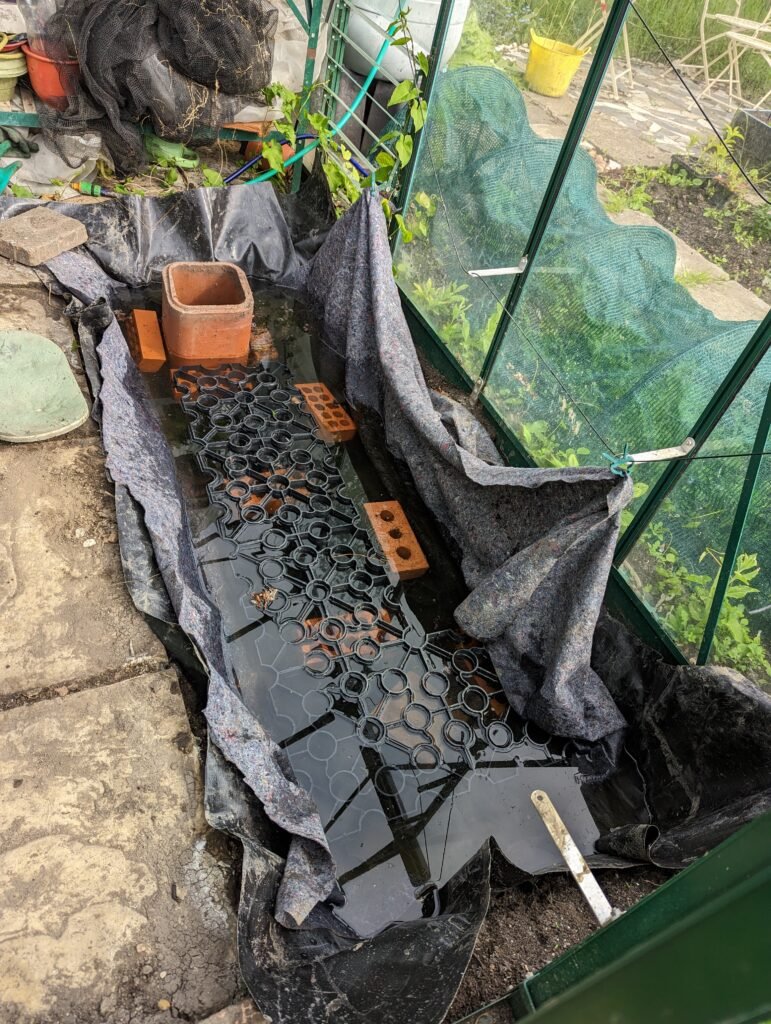
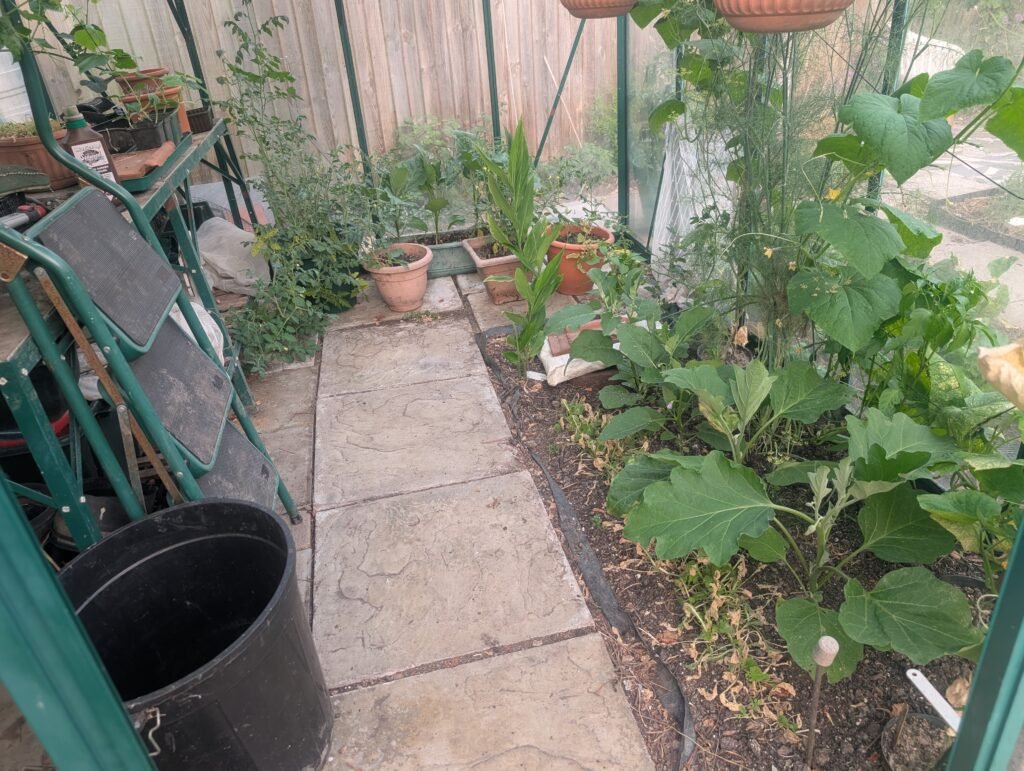
Top: The wicking bed in the large greenhouse now with cucumbers, aubergines, peppers and a row of (flee beatle ravished) Wong Bok.
Left: The skeleton of the wicking bed in the large greenhouse is being build. Next pond underlay has been put over the crates followed by soil.
Our biggest gadget is probably the wicking beds, one in each greenhouse. We dug out the soil, put a pondliner in each, made a reservoir at the bottom which can be filled at the top and filled it back up. It means that the greenhouse bed even in these temperatures only needs watering once a week, if not fortnightly.
I have also had success with saucers under pots (as sometimes the soil in the pot is too dry to take up any moisture, so rather than pour the water straight through it and waste it, slowly allow the soil to soak it up again). For trees I have used pieces of downpipe which allow water going straight to the roots.
Over the years I have tried out and have been less impressed by
- Drip-systems for pots: timers always break, solar watering panel also broke, but just a straight connection of the kit with the connecting pipes and onto the tap is time saving.
- Ola’s, which should work as they do so in far hotter climates than ours, but the plants just failed to draw the moisture from the pot. Not sure what we did wrong, if anything,
- Self-watering spikes, which either just drained straight away or not at all,
- Capillary matting works, but as soon as you have some empty space, the matting dries out and stops working. Compared to the wicking bed it also requires a lot of water.
Our garden now
Our garden is a third of an acre. It has lawns, flower beds, two vegetable gardens, a fruitcage, two greenhouses and a meadow. The flowers in the Spring were wonderful and most plants are doing well. The roses are coming back into flower and many others have wonderful blooms, even the lamenting hydrangeas.
The vegetables in the greenhouse are doing well, but some of the Autumn planted crops would have benefited from some more watering like the broadbeans and the garlic. I started some vegetables such as the beetroot too late, so those aren’t plentiful. The pumpkins, tomatoes, corn etc. are all growing well.
Failures, among other things, are the hedge that I am trying to establish in front of the fence. There are well established trees and shrubs on the other side and although some of the planted native hedging isn’t dead, alive is a better description than thriving. I planted some rudbeckias in a corner where it’s wet in Winter and those are struggling too, although I am hopeful that they’ll be fine in the end. One full bed in the flower garden is again not thriving, but as this is the same problem as last year, I think I need to start digging there come September and see what is hiding in the subsoil. I have also given up on the cut flower bed in the vegetable garden. I sowed part of it too late and I can't be bothered with the sweet peas anymore. The cornflowers still look lovely though.
Win some, lose some and lots to do for next year!
If you would like a consultation with regards to making your garden more drought resistant, please contact Purple Flowers Gardens and Mosaics.